Ant coloniesAnt hill, housing the commune Feeding the ant commune How ants communicate Soldier ants, their equipment< How ants carry on war Insects in ant colonies Ant community government Ant body parts Ant information Wood ant hill discovery Little black ants Internal structure of ants Ant nests Ant farm Ant cam Ant war online flash game |
Ant colonies > Soldier ants, their equipment
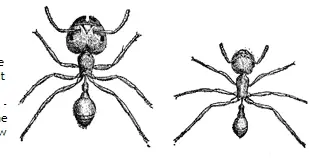
Soldier ants, their equipment War, it is said, is a brutal way of settling differences among men. That is true; and therein lies the fact which gives most serious pause to one who would study the subject philosophically, with an outlook upon nature at large. War is brutal - a natural habit of brutes, and of the whole realm of organized life below them, that wage war upon one another instinctively. Their natural life is one of endless conflict. They who justify war do so on the ground of its universal prevalence among creatures in a state of nature. It is brutal but natural, and man, being of nature, has his physical kinships with brutes and their lower allies. Nevertheless, he recognizes that to many minds the force of the facts, as seen in nature, is not readily put aside; and that the universal war habit of organized beings, as it appears to have existed in all time. seems to place upon a higher plane, as in harmony with natural laws, those war-like habits and acts that have dominated human history. This, at least, gives an exceptional interest to a study, for the sake of comparison, of the war methods of those lower orders of living beings whose social organizations strongly suggest our own. Among the foremost of these are ants, and ants, as an order, are war-like insects. The foragers carry their natural pugnacity into the field as isolated individuals, and show decided courage in the quest of food. Therein they are freebooters. Whatever falls in their way and they are able to possess, they take. This, as in the case of human brigands, often requires an appeal to force. An ant commune is as fair a scene of peaceful industry as a beehive; but everywhere in its vicinage "doth dogged war bristle his angry crest, and snarleth in the gentle eyes of peace." This readiness for hostilities and ferocity in attack have been noted and recorded often of the hosts of true ants that swarm along the pathways of travellers in the tropics. For example, Stanley speaks of the "belligerent warriors" arnong the innumerable species of various colors that filled the African forests; of the "hot-water ants," as his men not inaptly named them, from the smarting pain of their stings; and of the minute red ants that everywhere covered the forest leaves and attacked his pioneers so viciously that their backs were soon blistered. These creatures doubtless acted from a principle of self-defence that led them to hurl their fighting myriads upon everything that crossed their way and disturbed their solitudes, though with no hostile intent. It was an act of natural belligerency, and no doubt was protective, in the aggregate, of life. It certainly seemed as little reasonable as were the unprovoked attacks of the human hordes of cannibal savages that assailed his expedition in their crowded boats, as he made his way through the heart of the Dark Continent, along the mighty Livingstone River. The tribes of ants and the tribes of men were not unlike in the native combativeness that animated them. The woods within whose open spaces the moundmaking ants rear their conical cities are also hospitable to the carpenter ants (Camponotus pennsylvanicus), and the two species are natural enemies. Wherever they chance to meet a combat is inevitable, in which numbers sometimes become involved, and always death and wounds succeed. Should one of these errant Camponoti, from a nearby nest in a white-oak tree, chance to cross a mound-builder's bounds, its tread, light as it is, affects the commune like a signal-shot or a fire-alarm. From the nearest gates issue squads of sentinels, who fling themselves in mass upon the intruder. Flight is thus hindered, even if it were considered, and, despite the overwhelming odds, Camponotus joins battle, and only succumbs, and is dragged within the walls, after a number of its assailants have been maimed or slain. The agitation in such a case is limited to a narrow sphere, for somehow the commune knows that the clanger is merely local. Therefore, outside of that circle, the various duties of the government go quietly on. But it is a notable. feature of this commune that upon a general alarm the whole citizenship rises up to meet the threatening peril. Many times in many ways has the author tested this. A few pats of the foot or strokes of a stick upon the surface would call out a host of sentinels and workers. The interior construction of the mound is well adapted to communicate sound or vibratory movements rapidly. Through the conical mass of intercommunicating galleries and rooms the agitation at the surface appeared to be quickly carried to all parts of the mound. At all events, it reached enough to call out, almost instantaneously, a multitude of insects. With antennae erect and quivering, with abdomens well raised from the ground, with legs ajerk and heads aloft, they circled about and rushed to and fro, their whole mien showing keen excitement. With them, assuredly, "the toil of war" is "a pain that only seems to seek out danger." It is not a question of who has made the attack, or why made, or whether one or another should come to the rescue. At once the republic is ready to launch forth its entire force, if need be, against real or imaginary foes. This perfect unison in resisting the assault of an enemy is surely an element of civic strength and permanence. During my boyhood a saying of one of our naval heroes was widely current, and was a theme for discussion in some of our Ohio debating societies: "My country: may she always be right; but, right or wrong, my country!" No budding ant citizen would need to debate that question. The commune with ants always has absolute priority with all its citizens. Their supreme law is its demands, for life or for death. History and, indeed, our own observation have shown among men examples of somewhat smiliar communal unison under the impulse of great social movements. A wave of patriotic feeling will sweep over city or State or nation, and carry it swiftly along until the purpose or sentiment or ernotion that inspired the movement shall be spent in achievement or hopeless failure. Such movements are more unanimous, and so more harmonious, in ant than in human communes. There is absolute good temper and unanimity of feeling among the myriads of inhabitants of our emmet mound city in all movements noted, whether peaceful or warlike. Of course, one does not expect such complete fraternity among men, even in far less widely extended citizenships. Whether in this the bipeds or the sexipeds are better off and nearer to nature, let the reader query. If one were to indulge such a fancy as that human civics have developed from such lower and simpler forms as ants exhibit, it would seem that in the evolution they have been carried a long way (in some respects) from the original type. No trait in emmet character is more interesting than this entire devotion of every individual, even unto death, to the welfare of the community. The uprising of a threatened ant city is a remarkable exhibition. The peaceful commune is instantly transformed into an armed camp. There is not the slightest delay or hesitation in the response. With utter abandon the little creatures hurl themselves upon their assailants. No question seems to arise. Shall we abstain? Shall we retreat? Or shall we on the helmet of our foes Tall our devotion with revengeful arms?" No condition of size or character in the adversary has the least influence upon their action. There is no trace of personal fear, no regard for life, no balancing of probabilities as to victory or defeat, but with the most formidable as with the feeblest enemy the ants join eager issue. There is no "melangering." None hangs back waiting for others to take the brunt of battle. In our mound-making ants, cowardice is an unknown vice. I do not recall a clear case of poltrooncry. They are as valiant as they are industrious. In many cases the destruction of the defenders is foregone, and the foremost in the column are certain to perish. That may not be understood by them; but were it so, it would not make any difference with these citizen warriors, with whom labor, health, unlimited service - life itself - are held as the unreserved heritage of the commune. There have been times in the history of human commonwealths when a large portion of the citizenships reached as high a standard of patriotism. At all times there are some who, in the surrender of their substance, their service, themselves, and - yet higher sacrifice - their sons to the nation, show like devotion. But history would surely falter if challenged to find among men a case of unanimity in devotion to the commune in time of danger equal to that of the mound-making ants of the Alleghanies. A good example of the pugnacity and courage of ants is a small species (Dorymyrmex flavus), that digs its little nests upon the great open spaces surrounding the central mound of the occident ant of Colorado. A large commune of the latter which had been badly damaged by the wash of heavy rains was a scene of active rebuilding. Four moundlets of Dorymyrmex had been reared upon the pavement, one of them quite near a centre of operations in one of the main tracks by which the workers had ingress and egress. Here an incessant warfare was being waged by the dwarfs upon their big neighbors. Every occident that essayed the passage to or from the ground was attacked. Squads of Dorymyrmex surrounded their single gate, and on the approach of one of the occidents the nearest warrior flung herself upon the unconscious intruder. That she was alone, that there was such disparity in size between her and her adversary were facts that plainly had no part in her calculations. It was curious to note the effect upon Occidentalis. She stopped instantly; drew her feet closer together; stiffened the legs, thus raising her body well above the earth; bowed her back; elevated her head; stretched out the sensitive antennae, as though to guard them: specially from harm; opened the mandibles; and, in fact, presented an amusing likeness to the pose of a cat at the first onset of a dog. The fore leg upon which Dorymyrmex had seized, and which had instantly been raised, was then shaken violently, and the little assailant rolled upon the ground. Thereupon occident unbent herself and resumed her way. She scarcely had started ere her tormentor again was upon her, followed by another and another, until her body was dotted with the little vixens. They grasped her feet, fastened upon the under parts of the abdomen, mounted her back, seized her antennae. They could not be shaken off. She snapped at them with her strong jaws; struck at them with her claws; doubled her abdomen under her body, and thrust at them her barbed sting. Some were crushed, some were thrown off, but others came to the assault. Anon the warring mass rolled upon the ground, a whirling ball of red and dark yellow, of quivering legs and antennae. At last the aggressors were driven off, or released their hold, and occident retired to a safe distance, Combed her ruffled hair, and passed by on the other side. Some of the occidents, as soon as they neared the Dorymyrmex bounds, paused, and stood quite still, as though reconnoitring the hostile quarters. The pause was fatal, for they were attacked at once by the vigilant sentinels, who sallied forth to a goodly distance upon the avenue. Others seemed to recognize that discretion is the better part of valor, and made a wide detour of the skirmish line of the little vixenish raiders. It was plain that the occidents thoroughly knew the qualities and temper of their involuntary guests, and regarded them with wholesome distrust, not to say fear. The result of the guerilla warfare above described was rather remarkable. The next morning, upon visiting the ground, I found that the occidents had abandoned their old avenue, had cut down and around the Dorymyrmex colony, and made an opening on the edge of a slight ridge several inches beyond the disputed territory, but still in the line of the avenue they had been using. A little of the pains required for this last would have cut out and carried away the whole Dorymyrmex nest space, whose contingent of diminutive warriors could have been overwhelmed in a moment by the legions of their huge hosts. Subsequently the occidents made an amusing retaliation upon their wee tormentors, for I found their nest literally buried under the dirt excavated from the new gangway, and dumped upon their gate. and moundlet. It was a fitting and laughable punishment for the little churls, who, however, would probably cut their way out, unless the process were continued. These incidents will suffice to show that courage is a general characteristic of ants. But one finds herein the same temperamental differences that mark the tribes of men. As there are nations justly described as warlike, and others as peaceful, so among ants there are species whose natural disposition is bold, fierce, combative, and species that, in comparison, are timid and un-warlike. An apt illustration of this is given by Professor Wheeler, who found lodged in the leaves of a Mexican tillandsia, colonies of ants of several different species. They seemed to be living on good terms with one another, but were not so complacent toward their human observer. While tearing the leaves asunder the little Cremastogasters (brevispinosa) attacked him vigorously, though their lilliputian stings and mandibles hardly got through his outer skin. But the huge Camponotus abdominalis rushed out in a body, and the powerful jaws of the soldiers, reinforced by the copious formic acid batteries of the whole company, compelled him to give up his investigations. Two species of the grotesque genus Cryptocerus were as gentle as lambs, resting quietly on his hands and clothing. A group of timid little Leptothorax petiolatus took to their legs; while the superb, wasp-like Pseudomyrmas (gracilis) made dashes at the investigator from among their glistening larvae and pupae, but hastened back, as if afraid to leave their young. Here, at one view, could be noted the differences in natural combativeness which one sees among creatures of a larger sort. Professor Forel, during his visit to the United States, observed a small troop of sanguine ants attack a community of Formica subsericea. At the mere assault the latter betook themselves to flight, carrying their larvae and pupae. Even these they permitted the slave-making marauders to snatch away without serious resistance. In all his extensive and varied experience, Forel had not seen such complete and absurd cowardice. And yet the Subsericeas observed by me and there are numerous colonies on my own country place - while they are not conspicuous for warlikeness, are quite normal in their general courageousness. But there are no slave - making species in their vicinage. Their spirit has not been cowed through successive conquests by stronger and fiercer foes. They are, therefore, not open to that strange seizure which may beset ants as well as men, even the stoutest-mearted men, known as a panic. With ants, too, as with men, circumstances influence both personal and communal courage. Formica fusca, one of the favorite auxiliaries or so-called slaves of the sanguine slave-makers, has been observed by Wassmann and Forel to be more courageous with them than when nesting alone. Backed up by their redoubtable leaders and associates, they act as do men under similar circumstances, and stand to their weapons when otherwise they would retreat. Independent of other and tactical considerations, military men know the value of "reserves" in bracing up the troops on the firing-line by an appeal to the confidence that springs from consciousness of an efficient support to fall back upon. It is curious to note an experience somewhat like this in the above reflex as operative among ants. Naturally our thoughts, when turned to the subject of war, call up the forms of males as the sole or chief actors. So it is among men and the wild and domestic animals that we know best. Certainly there are women not lacking in belligerency, and when congregated in riotous mobs they have at times been fiercely combative. But in organized and communal fighting females rarely have had a part. War is a male occupation. In ant communes we strike another atmosphere. The difference between the male temperament in ants and in the human species is so great that we cannot frame a just basis for comparison. In man the masterful qualities have developed in the male and the dependent ones in the female. It is the reverse of this among ants. The male is a dependent, in whom capability of selfsupport and self-defence has been obliterated. The female - and it must be remembered that all workers are females in a stage of incomplete development - is the sole efficient servitor of the commune in peace and in war. The queen, or productive female, is The Commune in germ. She is THE ANT, in whom are centred all the qualities and functions of the whole race, save the power to quicken the eggs. She is the true "war lord" in the early stages of establishing a nation, and only when the foundations are securely fixed does she abdicate, and, effacing herself as a chief, retire from the toils and exposures of leadership, and give herself up to the duty of adding to the communal numbers, in and for which she is sheltered and protected by the force of the entire commune. Her original offices as builder, purveyor, caretaker, defender, pass over to the workers, and therewith the war-like spirit which communal safety requires. When the young males come upon the scene they are treasured for their one necessary function, and then cast off. They are not specialized as soldiers; nature has forbidden that by denying them defensive weapons; for a like reason they cannot work. They are simply dependents nature's beau ideal of the "gentleman loafer." Thus it comes about that all emmet warriors are veritable Amazons. It has been said that an ant commune presents the phenomenon of a social government where every active citizen - or "citizeness," if one fancies that term - is a warrior. Yet herein, also, we may record an exception that approximates them more closely to our own conception of a military organization wherein the fighting members are a separate class. One might use a stronger word; for in the course of human history soldiers have been not rarely a real caste. And, in truth, it amounts to that even now in some nations. Perhaps the "antimilitarism" that marks social agitations in certain quarters is simply a modern industrial swing away from the old bondage to a soldier caste. Be that as it may, nature shows us in ant communes examples, in various stages of development, of the differentiation of ordinary workers into soldiers. In many species the line of demarcation is not sharply drawn, but appears in the greater size, especially of the head and jaws, the important parts in attack and defence. But in other species the process has advanced to a distinct soldier caste whose characteristics are most decided. In the genus Pheidole we have species in which the functions of workers and soldiers are clearly separate. Of a Texas species, Pheidole instabilis, the workers alone, though of comparatively diminutive size, manage the colony's affairs. They forage for seeds or dead insects, which they drag to the nest. They dig out the galleries, carry about and tend the larvae and pupae, even the huge female ones, and assist to cut out the callows from their pupal envelopes. On the other hand, the soldiers have an office for which their abnormally large heads and strong jaws peculiarly fit them: they are the guardians of the nest. They form a sentinel cordon around the young brood and the callow antlings. They are stolid and inactive, keepers at home, but eschew the task of tending the communal babies. Their heads are so large proportionately to their bodies, that if turned upon their backs they are often unable to right themselves, and if not relieved may die practically standing on their heads. This bib headedness, with its corresponding development of the jaws, however, has led to a peculiar service. The soldiers act as the communal carvers or trenchers, and crack the shells of the oily seeds and the tough, chitinous eases of the insects which the foragers collect for the commissary department. Somewhat oddly, they abstain from levying toll upon the food supplies thus made ready for general use, but draw their rations directly from the comminuted stock in the workers' crops. This genus has representatives in the Eastern United States - Pheidole pennsylvanicus and Ph. megacephala. The author has made some notes of the habits and nest architecture of the former in his studies of the occident ant. As it is a harvesting ant, the massive heads of the soldiers may be utilized for the same service as those of P. instabilis. Another ant, the Florida harvester, Pogonomyrmex crudelis, which garners seeds, has large-headed soldiers, which perhaps may be found also to unite the function of policemen with that of trenchers. The genus Atta contributes examples of species provided with soldiers with exaggerated cephalic enlargement. In a Texas species, Atta fervens, the duties of these soldiers appear to have been specialized until they are as distinct as are their forms. This species is the well known cutting or parasol ant of Texas; whose defoliation of trees, for the enrichment of their cavernous "mushroom gardens," makes them a decided pest to farmers. In my studies of their habits it was noted that during their foraging excursions the vast columns of leaf-cutters and carriers were marshalled by the bigheaded soldiers. Both on the raid and on the return they accompanied the marching ranks, appearing to take no part in the actual work of the expedition, but moving back and forth along the flanks, after the fashion of scouts and pioneers, or of an official guard and escort. Other examples might be cited, but the above sufficiently illustrate the fact that in the military government of ant communes we meet with a feature analogous to that well-known characteristic of human societies: the differentiation of the functions of police and defence into a special class, or caste, known as soldiers and sailors. How far in this natural arrangement the industrial element among the ant citizens is dominated by the soldiers is not known-at least, to the present writer. Within certain lines - as, for example, submission to. their soldier escort by the leaf-cutters of Atta fervens - they permit the exercise, of legitimate authority. But they seem able to control the situation when so inclined. Professor Wheeler has seen the workers of Camponotus ferrugineus kill and dismember their soldiers in a case where the food supply of the commune had become insufficient. They thus at once showed that their guards were not their masters, and that workers held the first rank in their social order, though of course they incidentally demonstrated their lack of anything like "the quality of mercy" in their relations to their associates. In short, we may conclude, with reasonable assurance, that the government of ant communes is not a military despotism, and that soldiers, when specially differentiated, are simply a co-ordinate and subordinate part of the social organization. The weapons with which ants carry on their wars are placed at the extremities of the body. A pair of movable jaws, or mandibles, are attached by strong muscles to the face. They are palmate, toothed along the receding edges, terminating on the inside margin in a large pointed tooth or tusk. These two opposed instruments, working against each other, form the composite tool and war-weapon of ants. With these they dig their galleries in the earth, or carve them out of wood, cut down grass, defoliate trees, seize and cut up food of all sorts: Being palm-shaped as a rule, the gathered and comminuted material can be compressed into their hollows, and so carried as conveniently as in a basket or barrow. As the muscles permit the application of much or little force at the insect's will, the mandibles can be clamped together with power enough to break and tear tough fibres, or approximated so gently that the soft eggs and tender larva can be borne about as daintily as an infant in a mother's arms. Thus they aptly combine some of the qualities of the human hand with those of a beast's jaws. It is this instrument - for the two mandibles work together as one organ - that serves ants effectively as the chief weapon in their various combats; it is at once war-club, battle-axe, and sword; it will decapitate a foe with the facility of a sabre or guillotine, will sever a leg or antenna as deftly as a scimetar, or crush a skull in its formidable vise as would tomahawk or club. It is terrible to see, in the fierce encounter of emmet warriors, the cruel havoc wrought by this implement. As effective, perhaps, and fatal, but less apparent in its operation, is the, weapon attached to the opposite extremity. Enclosed within the vertex of the abdomen is an arrangement of organs known as the sting. In one great division of the ant genera these are veritable stinging organs, like those of bees and wasps. |

| © 2004 www.antcolonies.net |